Sir,
As a Londoner who has made his home in Jerusalem, I write to you with a tear in my eye. Yesterday's dreadful attack on Israeli citizens was not the first, nor will likely be the last, in a long chain.
September draws closer and the possibility of a Palestinian state becomes imminent, it is pertinent for us to ask ourselves whether the Palestinian leadership truly desire to live in peace with their Israeli neighbours. For all the talk of the evil of the occupation, Israelis have no assurances that the Palestinians seek to root out terrorism. Palestinian President Mahmoud Abbas might sound moderate, but scratch the surface and we see that terrorism is still glorified in the Territories. Just last year, Abbas dedicated a town square in the memory of Dalal Al-Mughrabi, a terrorist who hijacked a bus and murdered 37 Israelis in cold blood in 1978. Two summer camps also have the dubious honour of being named after this woman. It is evident that the Palestinian leadership is not interested in peaceful relations with Israel. Peace will only come when the Palestinians demonstrate their commitment to bring to justice and cease raising their children in an atmosphere of hate. Why is the Palestinian government not being pressured more to stop this wicked incitement? And why is Israel expected to allow a state characterised by such evil to arise?
Yours sincerely,
Elan Miller
Jerusalem
Showing posts with label Terrorists. Show all posts
Showing posts with label Terrorists. Show all posts
Friday, August 19, 2011


Thursday, April 28, 2011
Back to Down to Earth With a Bump
They say that the best way to compliment a pilot is to congratulate them on a smooth landing. From what I understand, it appears that one of pilots' pet peeves is when passengers complain about turbulence - "it's not as if we are jolting the controls or intentionally going through air pockets" - but landings, however, are far more within a pilot's domain and as such are seen as a good barometer of their skill.
Today, I came back home to Israel after a brief excursion in London to be with my family for Pesach. Upon arriving, I made my way to the airport shul (synagogue). There were only two or three other people about. Before I commenced my prayers, I noticed someone else coming in. From his position at the entrance, he was unable to see how many people were inside and so asked me whether there would be a minyan (group of 10 males) so that he may recite the traditional Kadish prayer for the deceased. I explained that there was not.
Realising that time was running out before the end of the time in which it is permissible to pray (until dusk), we eventually decided to pray by ourselves. In line with Jewish custom, the gentleman took a few steps backward as he was about to start, but before he started, I quickly interrupted his thoughts.
"Tfilati tihiyeh l'aliyat haneshamah shel?" I asked. (Loosely: "My prayer should be in the memory of who, exactly...?)
"Daniel Arieh ben Tamar".
And then he continued, "MeHapigua... Ani Ha'Aba Shelo." ([The boy] "From the terror attack. I'm his father.")
We exchanged weak, clichéd smiles. I nodded my head in recognition, and he nodded to thank me for my gesture. Wordlessly, we both turned forward to resume our prayers.
The second blessing of the "Shmona Esre", the central Jewish prayer that we then recited, reads thus:
"You are mighty forever, Hashem, Reviver of the dead; You are great[ly able] to save, Sustainer of the living with kindness, Reviver of the dead with abundant mercy, Supporter of the fallen, Healer of the sick, and Freer of the bound, and Maintainer of faith with those who sleep in the dust: who is like You, O Master of mighty deeds and who compares to You, O King who causes life death and death and causes salvation to flourish; and faithful are you to revive the dead. Blessed are You, Hashem, He who revives the dead."
As I said these words, I felt a deep, painful connection with the bereft father to my right. I'd landed back in Israel with bump, and it hurt.
Terrorism has many effects. It causes polarisation, and we must be wary of holding overly-extreme postions and believing unwise and often plain untrue things. No, not everyone is out to get Israel. No, not all Arabs hate Israel or support terrorism. Terrorism often causes people to adopt fundamentalist views. It has the double-effect of not only causing real damage, but also in making people cynical and less willing to deal with their enemies peacefully. Victims of terrorism are susceptible to making extreme responses, retaliating rashly and permitting many forms of behaviour that are otherwise deemed inadmissible. But I am glad that it seems that most Israelis refuse to. Israelis recognise, for the most part, that our enemy is not an entire people.
Nevertheless, I am reminded of just how differently the present conflict is perceived from abroad and from within Israel. People outside cannot possibly understand just how profoundly people here are affected by a conflict that has been going on for the best part of 100 years. This is not something which will be easily resolved. Sometimes I think it may not ever be solved at all, the way we are going.
For once, I won't make a political point other than to say that people can never understand us truly without spending a significant amount of time here. Of the many Jews I know and have met who live outisde of Israel, most think that they grasp the situation. But in reality, only very few people do see things as Israelis do. I am not pointing my finger or blaming anyone, but when Israel is described as more right wing than other Western societies, it is important to understand that this is not the result of latent hatred but of fear and pain.
Liberal values are all well and good, but in a scenario as explosive and volatile as ours, such values are open to exploitation. In order to safeguard them, Israel turns to the right. Again, I am not talking normatively, but it is important that we can identify this pattern of cause and effect. Judging, or better still, helping Israel can only be done effectively after this. We have a real enemy here, after all. It can't simply be ignored.
Monday, January 18, 2010
Two stories you might want to chew over, Part I:
As a regular visitor to timesonline.co.uk, the website of The Times of London, I read one story on Sunday with particular interest.
The article claims that Dr Muhammad Tahir-ul-Qadri, of a group called Minhaj-ul-Quran, has written a 600-page document which declares that attacks on innocent citizens are "absolutely against the teachings of Islam." Such a statement is clearly a good thing and will be welcomed almost universally outside of Islam. I am greatly encouraged that finally a mainstream Muslim group has taken a stance on the highly divisive and worrying matters of terrorism and extremism.
We are told that Islam is a religion of peace, and this in turn allows people to turn and deliver what they see as a winning blow by declaring such a title to be preposterous given the appararent Muslim predilection for blowing things up and treating women as sub-human. But I don't see things that way. I reserve my judgement until I have learned a significant amount more than I know at the present. Yes, terrible things are done by Muslims, any maybe even disproportinately so compared to the rest of the world's religions, but wasn't Christianity as a whole absolutely vile to the Jews in the Middle Ages? Now that the wild excesses of Christianity have subsided, it has become a relatively placid faith, but it too was a cause for rampant murder and strife centuries ago. We would do well not to judge Islam by it's fundamentalists. Yes, if we look to the Koran we will find numerous 'proofs' that it is, by nature, a violent religion. but so too are the Torah and the New Testament replete with verses that appear extreme. The key is in the interpretation. If Islam can prove itself to be, at its core, a religion of peace, then that is what its Imams and clerics must do at a time when its name is being seemingly besmirched by a violent and noisy minority. We hear so often of the silent majority, but there is no need for this to be a reality. Certainly not in the twenty-first century.
As a religious Jew, I obviously believe my religion to be the one true religion, but that doesn't mean that I see other religions as being totally, utterly evil. Nor does it mean that I perceive other religions' followers to be beyond hope. It is not against Judaic thought in any way to believe that a righteous gentile can be much, much closer to God than a Jew; and there are surely many such cases.
As such, while I think that Muslims have got this religion thing hopelessly wrong, (and no doubt they think much the same of me,) I don't feel the need to let them know that Judaism is the one true path — there's simply no point. Similarly, I don't think there's much point trying to sell Zionism to a nation who feel, rightly or wrongly, that this ideology violates their own rights. That's not to say that if a Muslim wants a reasoned debate with me on Zionism I will refuse, merely that I don't go out of my way to convince others as to the relative merits of my belief systems.
But while I feel that I need not justify Zionism, I applaud Dr. Tahir-ul-Qadri for his actions. He doesn't need to explain Islam to anyone else — it is his belief that being a Muslim is the correct way of life and he is entitled to it. What I applaud him for, however, is that he has decided to take a stance against those extremists who are hijacking his religion. (And I give Islam the benefit of the doubt here, because there is a doubt in my mind as to whether it truly is the vicious religion it is sometimes made out to be.) When I originally read this article, I accessed the Times website from my mobile phone. Beacuse of the limitations of mobile phone techonology, the Times' mobile internet site is stripped down and I didn't see the picture of Dr. Tahir-ul-Qadri that accompanies this article on the website when accessed from a regular computer. I worried that this man wouldn't be an orthodox Muslim, but would turn out to be some kind of reformist.
Having seen the picture now, it would seem that he is an orthodox Muslim, though. My concern was that had he not been a man who represented orthodox Islam, he would have been accused of selling out to the Western world and Western ideology. In much the same way that I regard the conservative and reform Judaism with deep distrust, (for I believe that they are constantly distancing themselves from original Judaism,) I am happy that this man seems to be a part of the orthodox Muslim establishment. If (orthodox) Islam really is a "Religion of Peace," then it needs to be proactive and make sure that all those who act violently in its name are thoroughly denounced. It seems unlikely that honour killings and suicide bombings can be actively prevented by the fundamentalists' fellow Muslims, but an atmosphere in which such heinous activities are branded as utterly unacceptable might help.
To be continued...
Wednesday, January 28, 2009
A bitter pill to swallow
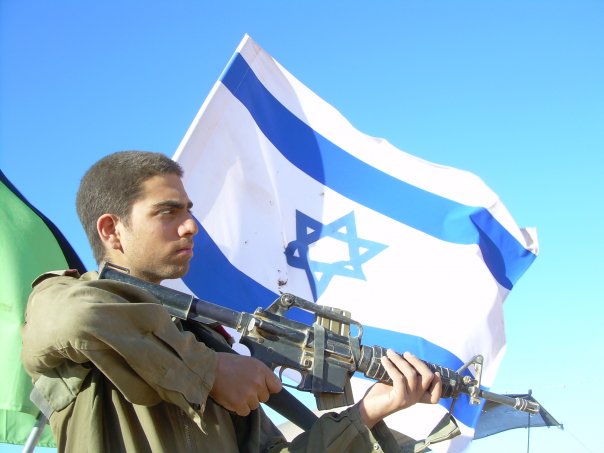
So the policy is now out in the open. Two years ago when I was in the army, I was doing guard duty near Ariel with another soldier. We had a fixed position and once an hour or so, one of us was to walk about 25 meters down the road from us and back to check the area. My colleague asked me if I understood the instructions we received earlier in the day. I replied to the negative; I hadn't a clue as I was still getting a feel for Ivrit at the time. He told me that if, while he was on his short patrol, I were to hear yelling from his direction I should shoot in the air to ward off any potential attackers. If I could see that we were getting into a kidnap situation, then I would have to do my best to neutralise the threat.
He went on to say that if the situation was that the terrorists looked to be succeeding in their struggle to kidnap him, and that I could not discern between his outline and the terrorists', I should shoot to kill all parties involved.
My friend explained that after the shenanigan that was the Second Lebanon War, the army is aware that terrorists are seeking to capture IDF soldiers to use as bargaining chips. He continued, saying that while this was not official army policy, it certainly has been unnoffically encouraged practise.
Yesterday, the cat was let out of the bag when a briefing given by the Magad (Battalion Commander) to Golani's 51st Battalion before they entered Gaza was was aired on Channel 10. The recording captures the Commander telling his soldiers that "Hamas' strategic weapon is to kidnap another soldier and I don't have to tell you, but no soldier from Battalion 51 gets kidnapped at any price and under any situation even if it means that he has to blow up his grenade together with those who are trying to kidnap him."
The IDF has furiously denied that these words were meant literally, and claims that this was motivational rhetoric in the commander's pep talk to his soldiers. The truth is somewhat different. Unfortunately, the IDF is all too familiar with the ramifications of a succesful soldier kidnap attempt. However, instructing a soldier to commit suicide grates with the IDF's ethos of leaving no man behind, and while it may be the best option available, it remains a bitter pill to swallow, and as such, has not been formally approved as policy. Additionally, as such a suicide (even under circumstances as extenuating these,) could well be against Halacha, the IDF has decided to adopt an informal apprach to this policy, opting to allow it spread via word-of-mouth. It would seem that this specific Battalion Commander inadvertently crossed the line by mentioning it to his soldiers formally, but the policy is equally effective when officially prescribed as when it is advisory practise.
Unsurprisingly, Jewish and Israeli blogs have seen a furious debate erupt over this policy. For a more in-depth look, read this page on VosIzNeias. Make sure to scroll down to read the comments people have left in response to the main article.
Wednesday, December 31, 2008
Finally a (grudging) mention
This article went online on the BBC's website last night. At first, I was pleased. A good article, so I thought, that refrained from blaming Israel. For that I should be grateful, I supposed.
But as I thought about what I had just read, I realised that several key points were missing. I realised that I was looking at yet another example of our enlightened left-wing, liberal-minded media studiously avoiding painting a full picture of what is happening in the Middle East.
I am currently studying for the American SAT. One of the subjects tested will be my essay writing skills. During my revision, I have learned that a good essay will take various sources and will make observations and progress to a mature conclusion. In that context, I am utterly dismayed that nowhere in the article is there mention of the word terrorist. True, that is unsurprising given the media's preference for the more sterile "militant," but "militant" doesn't appear either. "Hamas" is mentioned, but not once in connection with the suffering of the residents of Sderot at the hands of the rockets that they fire. Where would the BBC have us believe that these rockets appear from? Are they hoping to delude the public into thinking that rockets land in Sderot out of thin air?
Once again, the BBC is guilty of painting a misleading picture. The article mentions that the rockets come from Gaza, which is very true, but the point is that Hamas as administrators of the Gaza strip have both actively fired and passively overseen the firing of rockets aimed at civilians in Israeli towns such as Sderot. Which touches another point, that these rockets were aimed at civilians.
Why had such an article not been written before Israel's attack against Hamas? Why didn't the BBC feel that the situation, something that has been daily conversation here in Israel now for over two years, warranted a full-length article long ago? Why is it that when Israel responds to the terrorists the whole world sits up and takes notice, thoroughly condemning their "disproportionate" actions, but as rockets continued to hit Sderot throughout a ceasefire, the press' reaction was one of silence. Where was the international condemnation then? Where were the students protesting outside the embassies in solidarity with their Israeli brothers? (OK, I'm deluding myself a little there, but you surely catch my drift.)
Only after five days of this incursion/war in response to Hamas' insufferable provocation do the left-wing loonies at the BBC see fit to describe the suffering that Sderot residents are enduring. By way of comparison, countless articles have been posted online describing the suffering of Gazan residents as a result of the Israeli blockade and over these last five days many more have been published detailing their suffering in the latest bout of the conflict.
I have a sneaking feeling that the only reason why this article was compiled was merely so that their reporting of the situation could be perceived as balanced. To have masses of editorials online documenting the suffering of the helpless Palestinians, yet not one about the victims of Hamas's reprehensible "bad habit" of firing military grade weapons at civilians would be clearly indefencible proof of bias. Even the BBC would cannot tolerate such an absurdly assymetrical level of reporting.
By grudgingly producing the mimimal number of "pro-Israel" articles however, (and by that I mean "non-pro-Palestinian" articles,) the lefties can claim to be neutral and falsely assert that they are willing to equally report both sides of the conflict. They will self-righteously point to the few articles of this nature, and thus impudently deflect criticism of their one-sidedness. Do not be fooled.
In case we weren't absolutely sure why Israel launched this operation (Part 2):
Here is a short but powerful clip from Aish.com highlighting the effects of Hamas's terrorism that have caused Israel's recent operation.
Thursday, December 04, 2008
Indiscriminate?
I have been driven to post this entry upon seeing an exchange on Facebook last night. A friend of mine posted the following 'status update', "Karen is disturbed that her college chaplain believes the Islamists attacked their victims randomly and without regard to religious or national affiliation."
I was a little taken aback. Firstly because that is a foolish belief for anyone to hold. Secondly, because that's a Cambridge chaplain, not some average jo-shmo at Middlesex poly. Anyway, I don't get shocked anymore, there are plenty of different flavours of fools out there, and the intelligent are not immune.
A friend of Karen's commented: "Why? Those guys are known for attacking dudes indiscriminately. I'm sure they'd rather have killed lots of Jews and Americans, but they didn't. I'm sure the majority killed will transpire to be Hindus and Muslims, probably roughly divided along the lines of Bombay demography. How can you walk into a train station, randomly shoot the place up and still claim to be making targeted attacks? That seems like silly minutia to be bothered about - why not just accept that it was wrong to kill any civilian - Jews, Muslims, Americans or anybody else?"
What gets me is this word indiscriminate. It's like saying that they terrorists thought, "We don't care who we kill, we just want to cause mayhem!" These are religious and political acts; our villains aren't of the same mould as the Joker from Batman whose sole aim is to cause pandemonium. To anyone who insists on referring to any terror attack as indiscriminate, I ask the following simple question: When was the last time, if ever, a terrorist planted a bomb or detonated a suicide belt in his home, or in his place of worship? Or at the very least, in his village?
Seems a daft question. "Well of course they haven't done that!" you'd exclaim. What purpose would that serve? It would be utterly pointless and self-defeating to kill of their own. Herein lies the crux of the matter.
On September 11th 2001, individually random people were killed. That much is true. But there was a very specific target that day - American civilians. On 9/11, fear was struck into the heart of an entire nation, and the world looked on in awe. In London's 7/7 London Underground and bus attacks, random people were killed. Yes, one can argue that they were killed "indiscriminately," but the truth is that the act was far from haphazard. There was a very real aim, the fact is that it was not an indiscriminate attack. If it was, why didn't it happen in Bradford, where there is a far higher percentage of Muslims?
The attack was on London's heart and soul. Random people paid the ultimate price, but the real target was freedom of expression, justice and Western liberal values. The real aim was to kill heathens, non-believers, anyone who disagreed with the terrorists' extreme Muslim beliefs. (I hope that is read correctly.) The fact remains that these two heinous attacks took place on American and English soil, and not in Saudi Arabia or Iran. Yes, Muslims were killed, but far more "infidel" Christians and atheists were killed. It seems almost too obvious, but we cannot overlook it. The random nature of the individual murders must not overshadow the precise intent behind it.
During the nadir of the second Intifada, terrorists detonated bombs in crowded malls in Israel, and suicide bombers detonated their belts on Jerusalem buses among children and OAP's. There were no specific people assassinated. Does that mean that those people were indiscriminately killed?
The answer is an irrefutable no. Just because individual targets are not specified, does not mean that there is no overall target. The demographic makeup of a Jerusalem bus is rather different from your average West Bank suicide bomber's hometown. Admittedly, a Filipino worker might get killed, and so too might a fellow Muslim or two, but if you look at the death of toll of the second intifada, the overwhelming majority of casualties were Israelis, were Jews.
When, as happens from time to time, an angst-ridden teenage American enters a shopping mall and kills people at random, he chooses the mall because there are people there. There are targets and he can make a tremendous spectacle of himself. Location is everything.
I cannot offer an explanation for the anomaly that was the random shooting at the train station, but then again these terrorist don't seem to do logic, do they? It's only speculation, but my guess is that they wanted to stretch the police and the army and thus create a diversion for the other, even more chilling, part of their plans.
The attacks in Bombay were an assault on all things that did not conform to the terrorists' beliefs, on all things they deemed "unIslamic." We know that at the Taj Palace Hotel, the terrorists' first move was to obtain a list of all guests holding an American or British passport. They then attempted to round these people up and execute them. The Chabad house was a specific target, namely because it is one of the only Jewish centres in the city and as such attracted Jews and Israelis. Incidentally Chabad are a Haredi organisation, but unlike many other Haredi organisations, they are relatively pro-Israel. This must not go unnoticed, either. We found out later that the bodies of the married couple that ran the Chabad house were found to be in a far worse condition than others - the result of horrific torturing by their evil tormentors.
I cannot deny the basic element of randomness involved, but I state one last time, there was nothing indiscriminate about the intent of these attacks. A quick thesaurus check on Microsoft Word gives the synonyms "arbitrary" and haphazard" for indiscriminate. These were absolutely not haphazard or arbitrary attacks. So, does anyone else believe these attacks to be "indiscriminate," or is it just that simpleton Cambridge chaplain?
Subscribe to:
Posts (Atom)



 Posts


